
Order Tracking
Know Where Your order is
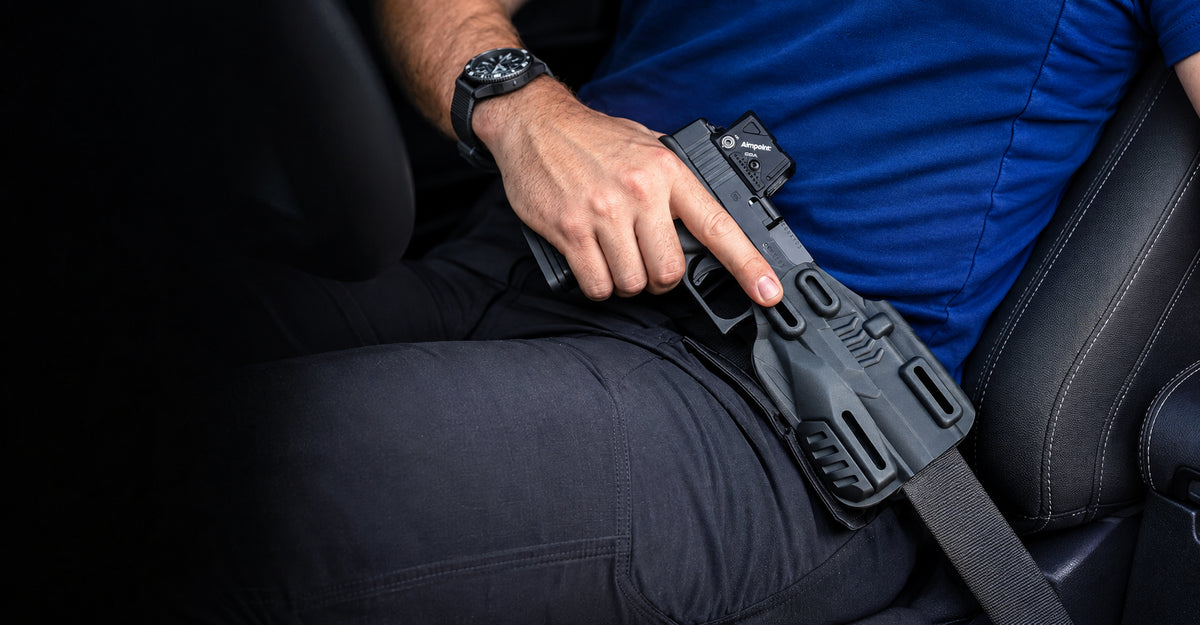



What works well on your feet at the range may work very differently once you're seated and belted. Compare the most common vehicle-carry methods and see how each performs in access, speed, safety, and practicality.

Familiar and widely used carry position.

Faster access than hip carry

Off-body storage within reach.

Dedicated vehicle position.

Utilizes existing storage space.

Designed specifically for seated, buckled carry.
Every carry method has tradeoffs. Choose a factor below to see
how each performs while seated and buckled.
The time required to draw the firearm from its carry position and bring it on target while seated and buckled.

The seat belt, seated position, and clothing can obstruct access to the firearm, requiring additional movement before the draw can begin. These obstacles can increase the time needed to bring the firearm on target.

The firearm's forward position can provide relatively direct access while seated. However, the lap belt, clothing, and restricted movement can slow the draw.

Access requires reaching away from the normal seated position and opening the console. The firearm can shift from its intended location or become buried beneath other items, requiring additional searching and movement that can delay retrieval.

A dedicated mounting position can provide relatively direct access without searching through a storage compartment. However, the speed of access depends on the mount's location, vehicle interior, and retention system.

The driver's door pocket typically requires a left-handed draw, creating an
awkward access angle for most right-handed carriers. Its low position and varying depth can further complicate retrieval and delay the time needed to bring the firearm on target.

The seat belt-mounted holster positions the firearm for a natural, cross-draw access while seated and buckled, avoiding the need to search through compartments or work around a waistband-mounted holster. Its dedicated position is designed to support fast, repeatable access.
How well the carry method supports secure retention, trigger protection, muzzle control, and safe firearm handling while seated.
A quality hip holster provides secure retention and trigger protection while keeping the firearm attached to the body.
However, the seat belt, clothing, and restricted movement while seated can complicate safe firearm handling during
the draw.
Appendix carry provides secure retention and trigger protection with a quality holster, but the firearm's position while the driver is seated often points the muzzle toward the groin or upper leg even before the draw begins. Drawing from that position also requires careful muzzle control to avoid sweeping the body as the firearm is brought up and out.
A properly secured firearm in a dedicated, enclosed console compartment can remain protected from unauthorized access and accidental contact. However, an unsecured firearm may shift during driving or a collision, potentially compromising retention and safe handling.
Manufacturers may cite strong static holding force, but a collision subjects the firearm and mount to sudden acceleration, change of direction, and dynamic loads that are very different from a stationary pull test. Depending on the mount design and retention method, those forces can challenge the system's ability to keep the firearm securely in place during a crash, potentially allowing it to become a loose object inside the vehicle.
A properly secured, holstered firearm in the door pocket can provide trigger protection and a dedicated storage location. However, retention depends on the holster and
pocket configuration, and the firearm may become unsecured during a collision or when the door is opened.
LapDraw utilizes a firearm-specific TXC holster for retention and trigger protection while positioning the firearm so the muzzle is directed away from the user while seated. That orientation is maintained through the initial draw path, eliminating the need to bring the muzzle across the groin or legs as the firearm is accessed.
The extent to which accessing the firearm requires visible movements that may reveal the carrier’s intentions
Accessing a hip-carried firearm while seated often requires a pronounced reach, torso shift, or movement around the seat belt. Those larger preparatory movements can make the draw more noticeable.
The firearm is positioned closer to the body's centerline, so access can require less obvious lateral movement than hip carry. Clothing and seat belt clearance can still create visible hand movement before the draw.
Opening the console, reaching inside, and retrieving the firearm creates multiple visible actions. Those movements can clearly indicate that the driver is reaching for something.
A well-placed mount can allow relatively direct access with limited searching or body movement. Telegraphing depends heavily on where the mount is located and how much reach is required.
Access can require relatively little upper-body movement because the hand moves down toward the driver's side. However, telegraphing can increase if the firearm has
shifted within the pocket, is partially covered by other items, or is not held in a consistent, secured position, since the carrier may need to search, adjust, or make additional movements before establishing a grip, especially if the user is right-handed.
LapDraw positions the firearm near the natural resting area of the hand, allowing cross-draw access with minimal searching, twisting, or large body movement. The shorter, more direct reach reduces the visible cues that typically precede a draw.
How easily the firearm can be located and accessed by feel without looking down, including in lowlight conditions, so the user can keep their eyes on a potential threat and maintain situational awareness.
A familiar hip position can often be located by feel, but the seat belt, clothing, and seated posture can obstruct the draw path. Because the firearm is close to the body, visually confirming clearance and muzzle direction is essential for safe access.
The firearm is in a predictable location and can technically be found without looking, but seated appendix carry places the muzzle near the groin and upper legs. That makes no- look access less desirable because careful visual and tactile confirmation is essential for maintaining safe muzzle control during the draw.
The firearm may not remain in exactly the same position inside the console and can be covered by other items. Without looking, the user may have to search by feel before establishing a secure grip, especially in low light.
A properly positioned mount gives the firearm a dedicated, repeatable location that can often be indexed by feel. Performance depends on the mount location and whether the firearm remains consistently oriented.
The driver's door pocket typically requires a left-handed draw, creating an
awkward access angle for most right-handed carriers. Its low position and varying depth can further complicate retrieval and delay the time needed to bring the firearm on target.
LapDraw keeps the firearm in a consistent, indexed position on the seatbelt near the user's hand. The repeatable location and defined holster orientation support access by feel without requiring the user to search for the firearm or look away from the surrounding environment.
The range of firearm makes and models supported by the carry system.
Hip carry accommodates a wide range of firearm makes, models, and sizes through dedicated, firearm-specific holsters. Users can select a holster designed for their particular firearm without the size constraints of a vehicle- mounted system.
Appendix carry supports a wide variety of firearm makes and models through purpose-built holsters that provide a precise fit. Firearm size and individual comfort may influence which models are practical for seated carry.
A center console may accommodate firearms of various sizes, but compatibility depends on the compartment's dimensions and how the firearm is secured. Without a dedicated, properly fitted holster, the console alone cannot ensure consistent retention or trigger protection.
Many fixed and magnetic mounts feature universal-fit designs that accommodate a broad range of firearm makes and models. However, compatibility does not necessarily guarantee firearm specific retention or complete trigger protection.
Door pockets can accommodate different firearm makes and models, depending on the pocket's dimensions and the
firearm's size. However, fit and retention vary considerably, particularly when the firearm is not secured in a dedicated
holster.
LapDraw incorporates firearm-specific TXC holsters designed for select subcompact handgun models. Its seat belt-mounted design prioritizes compact firearms that can fit between the seat and B pillar as the seatbelt retracts, making larger and heavier handguns impractical for this system.
How well the carry method accommodates access while seated with the seat belt fastened.
The seat belt, seat back, and seated posture can obstruct access to a hip-carried firearm, often requiring significant body movement or adjustment. Conventional hip holsters are primarily designed for carrying on the body rather than accessing a firearm while seated and buckled.
Appendix carry positions the firearm toward the front of the body, providing a more accessible location while seated than traditional hip carry. However, the lap belt can cross over or press against the holster, complicating access and potentially requiring adjustments before the firearm can be drawn.
The center console is generally accessible while seated and buckled, without interference from the seat belt or waistband. However, reaching into the compartment may require leaning or twisting, and access can be affected by
the console's design and contents.
A properly positioned mount can keep the firearm accessible without interference from the seat belt or clothing. However, accessibility depends on the mounting location and vehicle interior, which may require reaching or adjusting body position while buckled.
The driver's door pocket can typically be reached without unbuckling or working around the waistband. However, its low, lateral position may require an awkward reach, and accessibility varies with the pocket's design and the firearm's placement.
LapDraw is specifically designed for seated, buckled carry, positioning the holstered firearm directly on the lap portion of the seatbelt. This dedicated location keeps the firearm accessible without requiring the user to unbuckle or work
around a conventional waistband holster.
The ability to access the firearm without requiring the assistance of the opposite hand.
The seatbelt and clothing can obstruct access to a hip- carried firearm while seated. Managing these obstructions typically requires both hands to establish a secure grip and maintain safe firearm handling.
Clothing and the lap belt can obstruct access to an appendix-carried firearm, often requiring the opposite hand to manage these obstructions safely. The firearm's proximity to the body also makes maintaining safe muzzle direction particularly important.
Access requires opening the console before retrieving the firearm, creating an additional action that may require the opposite hand. Although one-handed retrieval may be possible, the console's design, contents, and firearm placement can make it less consistent.
A properly positioned mount can provide direct, one- handed access without opening compartments or managing clothing. However, the mounting location and retention mechanism may affect how easily the firearm can be accessed with one hand.
A firearm in the driver's door pocket may be accessible with the left hand, but right-handed carriers may need to transfer it to their dominant hand. The pocket's design and the firearm's position can further complicate
one-handed access.
LapDraw positions the holstered firearm on the seatbelt for direct, one-handed access without requiring the opposite hand to clear clothing or manage a waistband holster. Its
dedicated position is designed to keep the support hand available while seated and buckled.
Whether the carry system can be installed and removed without drilling, adhesives, or permanent changes to the vehicle.
Hip carry remains entirely on the user's body and requires no changes to the vehicle. There is nothing to install, drill, or attach to the interior.
Like hip carry, appendix carry stays on the user's body and does not require any vehicle modification. The carry setup moves with the user rather than being installed in the car.
A firearm can often be carried in the center console without modifying the vehicle at all. However, some users add dedicated holsters, lockboxes, or mounting hardware inside the console, which may require drilling or permanent attachment.
The most secure fixed or magnetic mounts typically require screws or drilling into the console or another part of the vehicle, creating permanent holes and the possibility of contacting hidden wiring, sensors, or airbag components.
Adhesive-mounted alternatives avoid drilling, but can be less dependable under heat, impact, or collision forces and may leave residue or surface damage when removed.
Using the existing door pocket requires no drilling, adhesive, or alteration to the vehicle. The firearm simply uses a storage area already built into the door.
LapDraw attaches to the existing seatbelt, requiring no drilling, adhesive, or permanent vehicle changes. It can be removed without leaving holes, residue, or damage to the interior.
Ratings reflect typical use while seated and buckled. Individual results vary by firearm, holster, vehicle, clothing, and training.
Everything changes when you’re buckled in
See how access, safety, and control change behind the wheel.
 01
 02
 03
 04
 05
 06
Same person. Same seated, buckled position. Real-world comparison.

Keep your firearm secure, accessible and ready when it matters most.
Built for stability and peace of mind.
All-day comfort without the bulk.
Made for real-world performance.


Positioned at your hip for a
natural, fast draw.

Installs on the lower seat belt area. 100% driver safe.

Installs in seconds.
No tools required.


Proudly designed and made
in the USA.

Keeps the holster compact and unobtrusive inside the vehicle.

Firearm-specific TXC Delta holsters provide a secure, precise fit for supported models.
LapDraw is designed specifically for subcompact firearms. Larger and heavier handguns can be impractical in the limited space between the driver, seat, seat belt, and vehicle interior, and may add more weight than is suitable for a seat belt mounted system. LapDraw is offered for select popular subcompact models using TXC Holsters’ Delta platform. As additional compatible Delta holsters become available, we plan to expand the LapDraw lineup.
Join our email list to receive updates as new firearm models are added. You can also let us know what model you’d like to see by contacting us at hey@lapdraw.com. Customer requests help us understand which models to prioritize as we expand the lineup.
LapDraw is currently available for right-handed draw only. Because the system is designed specifically around the driver’s seat belt, the holster position and draw path are optimized for a right-handed crossdraw from the driver’s seat.
LapDraw is designed to be discreet inside the vehicle. Black helps the holster blend naturally with most seat belts, seats, and vehicle interiors while maintaining a clean, understated appearance.
Yes. Like other Kydex holsters, this Kydex holster can soften or deform if exposed to excessive heat, especially inside a closed vehicle in direct sunlight.
To help prevent warping, avoid leaving the holster exposed to extreme interior temperatures for extended periods. When possible, reduce heat buildup by parking in the shade, using a windshield sunshade, or cracking the windows where permitted and safe to do so. If the holster has been exposed to significant heat, inspect it before use and confirm that the firearm still fits properly and retention remains appropriate.
Heat-related warping or deformation is caused by excessive temperature exposure and is not considered a manufacturing defect.
The LapDraw Holster system was developed in partnership with TXC Holsters and uses the TXC Delta because its compact, minimalist design is especially well suited to the confined space of a vehicle interior. The Delta is a premium holster that provides firearm-specific fit, retention, and trigger coverage while keeping the overall LapDraw system as compact as possible.
Most users leave LapDraw installed on the seat belt between uses. When the seat belt retracts, the holster typically rests in the space between the seat and the vehicle’s B-pillar. Because every vehicle is different, we recommend checking this space before purchasing. Depending on the firearm model and retention setting, the LapDraw Holster typically requires approximately 1¾" to 2" of clearance.
If you plan to leave LapDraw installed on the seat belt, make sure your vehicle provides enough room for the holster to rest comfortably without being compressed.
Yes! The base plate attaches to the holster with two screws, and one screw travels within a curved slot that allows you to adjust the holster’s cant.
To make an adjustment, slightly loosen both screws, rotate the base plate to your preferred angle, then gently retighten the screws to secure it in place. Do not overtighten the screws, as this could damage or break the base plate.
For a step-by-step demonstration, see our video on adjusting the cant here.

Know Where Your order is

looking out for you

Here when you need us